 using WordPress and
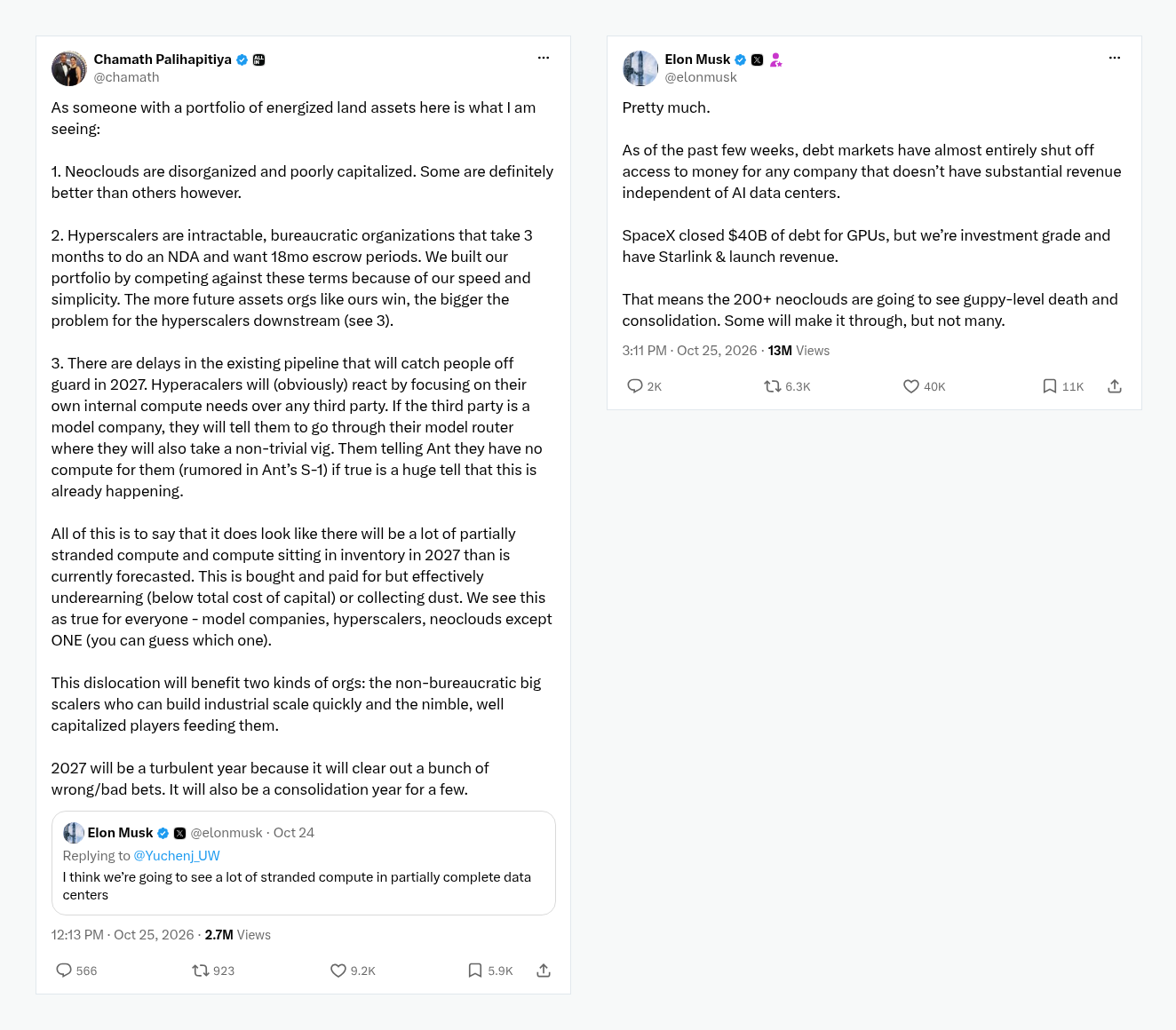
On Sunday, Elon Musk responded by quoting investor Chamath Palihapitiya’s post about the AI data center buildout, writing “Pretty much,” then adding:
“As of the past few weeks, debt markets have almost entirely shut off access to money for any company that doesn’t have substantial revenue independent of AI data centers. SpaceX closed $40B of debt for GPUs, but we’re investment grade and have Starlink & launch revenue. That means the 200+ neoclouds are going to see guppy-level death and consolidation. Some will make it through, but not many.”
That’s his post from 3:11 p.m. Eastern on October 25. When someone suggested he was talking the sector down to buy companies cheap, he replied: “SpaceX is not buying any neoclouds. Pointless.”
I’m not going to predict which companies make it. (CNBC notes SpaceX sells compute too.) I want to take apart the mechanics, because neocloud debt rhymes with two busts most of us remember: the telecom crash of 2000 and the housing crisis of 2008.
What a neocloud is, and how neocloud debt works
A neocloud is a cloud provider built to rent GPU compute for AI: CoreWeave, Nebius, Lambda, Crusoe and a long tail of smaller shops. There’s no ad business or online store underneath; it’s racks of GPUs, power, cooling and a fast network, rented to AI labs and enterprises. An October 2026 review by AcadeResearch cites counts ranging from 147 under a strict definition to 323 in SemiAnalysis’s broader tracking, so Musk’s “200+” falls inside that range.
The model: borrow money, buy GPUs, rent them out, and pay off the loan before the chips stop being worth much. The GPUs often serve as collateral: in 2023 CoreWeave raised $2.3 billion in debt collateralized by Nvidia chips, led by Magnetar and Blackstone.
The structures have matured. CoreWeave’s $8.5 billion delayed draw term loan from March 2026 sits inside a separate, bankruptcy-remote company that owns the GPUs, and on April 3, 2026, Morningstar DBRS rated it A (low) because repayment during an approximately five-year amortization period is underwritten by a services agreement with Meta. The well-built version has a creditworthy tenant behind it, not just a pile of chips.
The leverage is large. CoreWeave’s quarterly report for the period ended June 30, 2026 shows $35.551 billion of debt principal against $5.524 billion of cash and cash equivalents, about 6.4 times as much debt as cash by my math. The filing schedules $4.413 billion of that principal for the rest of 2026 and $6.184 billion in 2027. It also reports $103.7 billion of remaining performance obligations, meaning contracted revenue not yet recognized. And Fortune reported on October 26 that CoreWeave’s credit default swaps implied “more than 60%” odds of default over the next five years. That’s the market’s pricing, not mine.
Why “guppy” fits
Guppies multiply fast, and most of the babies don’t make it.
Gartner said the same thing on October 14 in drier language: by 2030, “cost pressure and a lack of a differentiating business model will force over 80% of neocloud providers to cease independent operations.” Gartner’s analyst told TechTarget that can “include acquisition” or “partnerships,” not just failure.
Why it matters right now
According to Reuters on October 26, shares of CoreWeave, Nebius and IREN had already fallen more than 30% this month, and some of CoreWeave’s and Nebius’s bonds hit record lows. On Monday premarket, CoreWeave fell 4.5%, Nebius 3.4% and IREN 3.3%. (CNBC reports all three rebounded and turned positive later in the day.)
Is the debt market really “almost entirely shut”? It looks narrowed more than closed. On September 22, 2026, CoreWeave completed a $4.2 billion offering of 2.875% convertible senior notes due 2033. Musk’s own deal needs a footnote, too. SpaceX’s SEC filing describes a binding commitment, entered October 24, to a master finance lease of approximately $40 billion with an Apollo-managed entity, expected to close before year end; the filing warns it may not close at all.
Here’s the surprise: demand isn’t the problem today. The Ornn Compute Price Index, which tracks executed rental trades, settled on October 26 with an H100 SXM at $3.17 per GPU-hour, up 24.80% over one month, and a B200 at $9.76, up 21.39%. That’s the opposite of a glut. The worry is what comes next. Palihapitiya expects “a lot of partially stranded compute and compute sitting in inventory in 2027,” and Musk wrote on the evening of October 24 that “we’re going to see a lot of stranded compute in partially complete data centers.” Gartner’s release adds that through 2030, AI data center owners would need a cumulative $8.5 trillion in revenue to cover capital spending, financing costs and a 12% return on invested capital, against attributable AI revenue forecast at no more than $3.6 trillion. By my subtraction, that’s a $4.9 trillion gap.
So the question isn’t whether AI demand is real. It’s whether revenue arrives fast enough to pay the debt before the chips lose their value.
The clock problem: depreciation vs. loan terms
Every GPU loan is a race between two clocks. Effective January 1, 2023, CoreWeave changed the estimated useful life of its data center computing equipment from five to six years, depreciated on a straight line, per its annual report. Michael Burry pegs the real useful life at “around two to three years.” The loans sit in between: the Meta-backed CoreWeave loan amortizes over approximately five years after an approximately 15-month draw period, and SpaceX’s lease schedules run approximately five to five and one-quarter years, with one-twentieth of the financed cost due each quarter.
A hypothetical, not any company’s real numbers: on a loan repaying one-twentieth of principal per quarter, 40% is still owed after three years. A six-year straight-line schedule still carries the GPUs at 50% of cost. If Burry’s three-year upper estimate is right, the chips are spent with 40% of the loan left.
To be fair to the bulls, older chips keep working: the same Ornn index settled the older A100 SXM4 at $1.09 an hour on October 26. But the rent has to cover the payment, and the payment doesn’t care which generation is in the rack.
If you buy compute for a living, this is the same math behind renting vs. owning in my AI rent vs. own vs. hybrid TCO model. Plug in a shorter useful life and watch what happens to the “own” column.
The 2000 parallel: dark fiber and vendor financing
In the late 1990s, telecom companies borrowed heavily to lay fiber on the theory that internet traffic would grow forever. Traffic grew, just not fast enough. On June 20, 2001, InternetNews reported that more than $90 billion in fiber had been laid in the previous four years and that Merrill Lynch estimated only 2.6% of it was in use. Global Crossing filed for bankruptcy on January 28, 2002, with $12.5 billion in debts. “Stranded compute in partially complete data centers” is the 2026 version of dark fiber.
The second rhyme is vendor financing. By the end of 2000, nine equipment makers including Lucent, Nortel and Cisco had extended an estimated $25.6 billion to their own customers, according to McKinsey figures cited by CFO.com. By the time that March 2003 article ran, 24 of the 30 largest public telecom service providers were bankrupt, and Lucent and Nortel were “on the brink of insolvency.” Today, Nvidia has invested in customers that buy its chips, and in September 2025 it agreed to buy CoreWeave’s residual unsold capacity through April 13, 2032 under an order with an initial value of $6.3 billion. The Guardian says these deals “resemble vendor financing,” and Nvidia has pushed back, saying it “does not rely on vendor financing arrangements to grow revenue.”
Where the analogy breaks: that fiber sat mostly dark, while today’s GPUs rent at rising prices. And bankruptcy didn’t erase the fiber; it stayed in the ground for new owners.
The 2008 parallel: borrowing against an asset that only holds value in a boom
The housing crisis ran on a simple loop. Lenders lent against houses priced as if values would keep rising. When prices fell, collateral was worth less than the loans, lenders pulled back, forced sales pushed prices lower, and the spiral fed itself. The Financial Crisis Inquiry Commission documented how leverage turned that into a financial crisis.
Swap “house” for “GPU” and you get the same shape: the collateral value assumes rental rates hold. If several neoclouds failed at once and lenders dumped repossessed GPUs on the market, rental and resale prices could fall for everyone, including the healthy operators. To be clear, that’s a hypothetical; the AcadeResearch review found no neocloud of scale had failed or been acquired in 2026.
Concentration rhymes too. Alberto Gallo of Andromeda Capital told Reuters that the debt “has concentrated credit markets into one risk, paying investors very little.”
Where this analogy breaks: in 2008 the borrowers were households and the lenders were banks running on thin capital and short-term funding. Today the borrowers are companies, and much of the lending comes from private credit. In July 2025, Morgan Stanley projected an “$800bn+ growth opportunity” for private credit in data center investment through 2028. That money is generally locked up longer, making a bank-style run less likely, but it’s also less visible.
Side by side
| Dot-com and telecom (2000) | Housing (2008) | Neoclouds (2026) | |
|---|---|---|---|
| The asset | Fiber and network gear | Houses | GPUs and data centers |
| How it was paid for | Junk bonds, vendor loans | Mortgages, securitized and resold | GPU-backed loans, leases, private credit |
| The bet | Internet traffic grows forever | Home prices only go up | AI compute demand outruns supply for years |
| What broke | Capacity far ahead of demand | Collateral values fell, credit froze | Not broken; credit is tightening |
| Who held the risk | Telecom investors and equipment makers | Banks, households, the financial system | Bond holders, private credit, chipmakers |
| Real demand underneath? | Yes, just later | Yes, but prices outran it | Yes, and rental prices are rising today |
What it could mean for the broader economy
Credit markets. Expect a wider gap in borrowing costs between diversified companies and pure plays. Single-business GPU clouds will pay more, or get less.
The data center and power buildout. Partially built sites feel it first: contractors, suppliers, utilities and towns counting on new tax base.
AI startups as tenants. Distressed capacity could get cheaper, but consolidation gives survivors pricing power, and Palihapitiya expects hyperscalers to prioritize their own compute needs.
Hyperscalers aren’t immune. Meta reported on October 21, 2026 that third quarter free cash flow was negative $2.12 billion, with $34.91 billion of capital expenditures against $32.79 billion of operating cash flow. The difference: Meta has an ad business to absorb it.
My read: this looks more like a painful shakeout in one corner of the market than a 2008-style systemic event, unless the private credit exposure turns out to be bigger and more concentrated than anyone is reporting. That’s the part I’d keep an eye on.
What to watch
- GPU rental price indexes. A sustained drop would be the first real sign of a glut.
- Neocloud bond prices and credit default swap spreads.
- Whether the SpaceX lease actually closes on the terms in its filing.
- Whether the first consolidation deals are acquisitions or bankruptcies.
If you run infrastructure and rent GPU capacity from anyone, ask the question nobody asks during a boom: what happens to your workloads if your provider gets acquired, or stops paying its lender? Hope isn’t a strategy, and neither is a single provider.
I’m not a financial advisor, and nothing here is investment advice. This is an infrastructure person reading public filings and news; do your own homework.
No responses yet